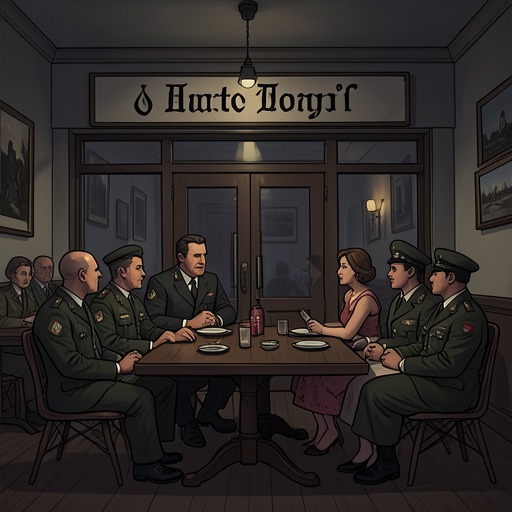
General and Madame’s Marriage
The SympathizerThe General and Madame’s Marriage is a partnership tested by exile, in which public solidarity and shared political commitments coexist with domestic disruption and anxiety over their daughter, Lana. The novel presents their relationship less through private declarations of affection than through the work they do together: appearing as a couple before political allies, defending a shared anticommunist outlook, and adapting to a household in which the old division of labor no longer holds.
Public Partnership in Exile
On the drive from Hollywood to Huntington Beach, The General and Madame sit together in the back of a Chevrolet Nova while The unnamed narrator chauffeurs them to lunch with The Anti-Communist Congressman and his wife, Rita. The narrator reflects that his role as chauffeur makes their situation look more substantial than their car or circumstances might suggest: they still have a driver, a remnant of the life and rank they once possessed. Their position beside one another lends that performance a marital form, but it also makes visible how much of their former standing has become appearance and memory.
The drive turns toward Lana, whose public singing has angered Madame. She calls her daughter insane, objects to her appearance, and fears that American permissiveness will expose her to sex, drugs, and a loosening of parental authority. The General does not interrupt this exchange in the available scene; the narrator sees Madame’s fury in the rearview mirror and answers her criticism by acknowledging Lana’s talent. The episode shows a marriage organized around family reputation and parental concern, but also reveals that the couple’s response to their daughter is not the narrator’s: Madame interprets Lana’s independence as a danger to the family’s moral boundaries.
At lunch, Madame carries the same concerns into a political conversation with Rita. The two women find common ground in their opposition to communism and in their belief that family life is vulnerable to ideological and cultural corruption. Rita’s rules for her own children reinforce Madame’s complaint about dating and American sexual permissiveness. The General and Madame’s marriage thus appears within a broader alliance: the couple’s private apprehensions about Lana become part of a shared political language with the Congressman and Rita, who treat social behavior as evidence in an anticommunist struggle.
Domestic Roles Reversed by Displacement
The household scenes give that public partnership a more intimate, material dimension. Madame cooks pho for The unnamed narrator, a task she had not performed before arriving in the United States. Exile has made cooking necessary because no one else in the household can do more than boil water. The General, despite being able to fieldstrip and reassemble an M16 blindfolded, finds a gas stove perplexing; the narrator also describes him as unwilling to be touched by domestic work. The contrast is pointed: military competence remains available to The General, while the everyday household skills required by their changed circumstances fall to Madame.
The meal also carries memories that do not belong to the couple alone. Madame’s pho recalls the narrator’s childhood kitchen and his mother’s broth made from bones left over by his father. The dish connects Madame’s new domestic labor to an earlier model of maternal care, while revealing how exile makes ordinary acts of cooking bear the weight of lost home. The General eats quickly and, like the other Vietnamese men the narrator describes, remains outside the domestic labor that has become necessary. The scene does not establish a new balance between husband and wife; it shows Madame taking on a role that circumstance has imposed while The General’s distance from domesticity persists.
Shared Status, Unequal Loss
The General’s military identity also shapes how the marriage is presented. When he gathers volunteers to build an exiled army, Madame tailors his surplus-store camouflage uniform to fit. The practical act helps restore the appearance of the officer he once was: in uniform, with a red beret, polished field boots, collar stars, and an Airborne patch, The General no longer looks like a proprietor counting money at a liquor store or restaurant. Madame’s work is one of the concrete contributions behind that transformation. The uniform offers The General a renewed public identity, while the marriage is shown supporting the effort that makes the identity legible again.
Yet the couple’s household remains marked by the losses that military display cannot reverse. The General describes exiled men as living in apartments that feel like jail cells without bars, their authority diminished as their wives work and their children master English faster than their fathers. He speaks of American rescue as a second injury, one that has left Vietnamese men without their former sense of manhood. These remarks are presented as a wider diagnosis of exile rather than a specific account of his marriage, but they illuminate the social pressure surrounding it: military defeat and displacement unsettle the gender roles on which many of the men’s former authority depended.
The Marriage Between Home and Politics
The General and Madame are also framed by the objects and rituals of their displaced life. A hardwood clock shaped like Vietnam hangs near the defeated republic’s flag and a beer advertisement. Its dial places Saigon at the center, turning the lost country into both a homeland and a measure of time. The narrator observes the clock while speaking with Madame, and its presence makes their domestic setting part of a larger exile: the question haunting displaced people is not only where they live, but how long return will take. The couple’s life together is situated within that suspended expectation.
Across these scenes, the marriage is neither reduced to affection nor presented as free of strain. Its visible forms are practical and political: sharing the back seat on a visit to an ally, confronting their daughter’s independence, maintaining a household under altered conditions, and helping The General recover the outward signs of military command. Madame’s cooking and tailoring make adaptation tangible, while The General’s continuing attachment to soldierly authority marks the limits of that adaptation. Their partnership endures in the evidence as a shared life organized around family, anticommunist conviction, and the effort to preserve dignity after the world that once secured their status has disappeared.